Bridging the Gap Between Digital and Physical Interfaces
The landscape of online gaming has undergone a massive architectural shift over the last decade. While the early 2000s were dominated by static, purely software-based interfaces driven exclusively by Random Number Generators (RNG), the modern sector is defined by a hybrid model. This model—Live Dealer technology—represents one of the most complex integrations of real-time streaming, optical recognition, and gamification mechanics in the digital entertainment space.
For industry observers and developers, the fascination lies not in the act of betting, but in the seamless synchronization required to make these games function. It is a sector where sub-second latency meets high-definition broadcasting, creating an environment where traditional table games are being reimagined through the lens of modern video game design.
The Technological Backbone: OCR and Latency Management
To understand the current state of live gaming, one must first appreciate the underlying infrastructure. A live casino floor is not merely a studio with a camera; it is a data-heavy environment.
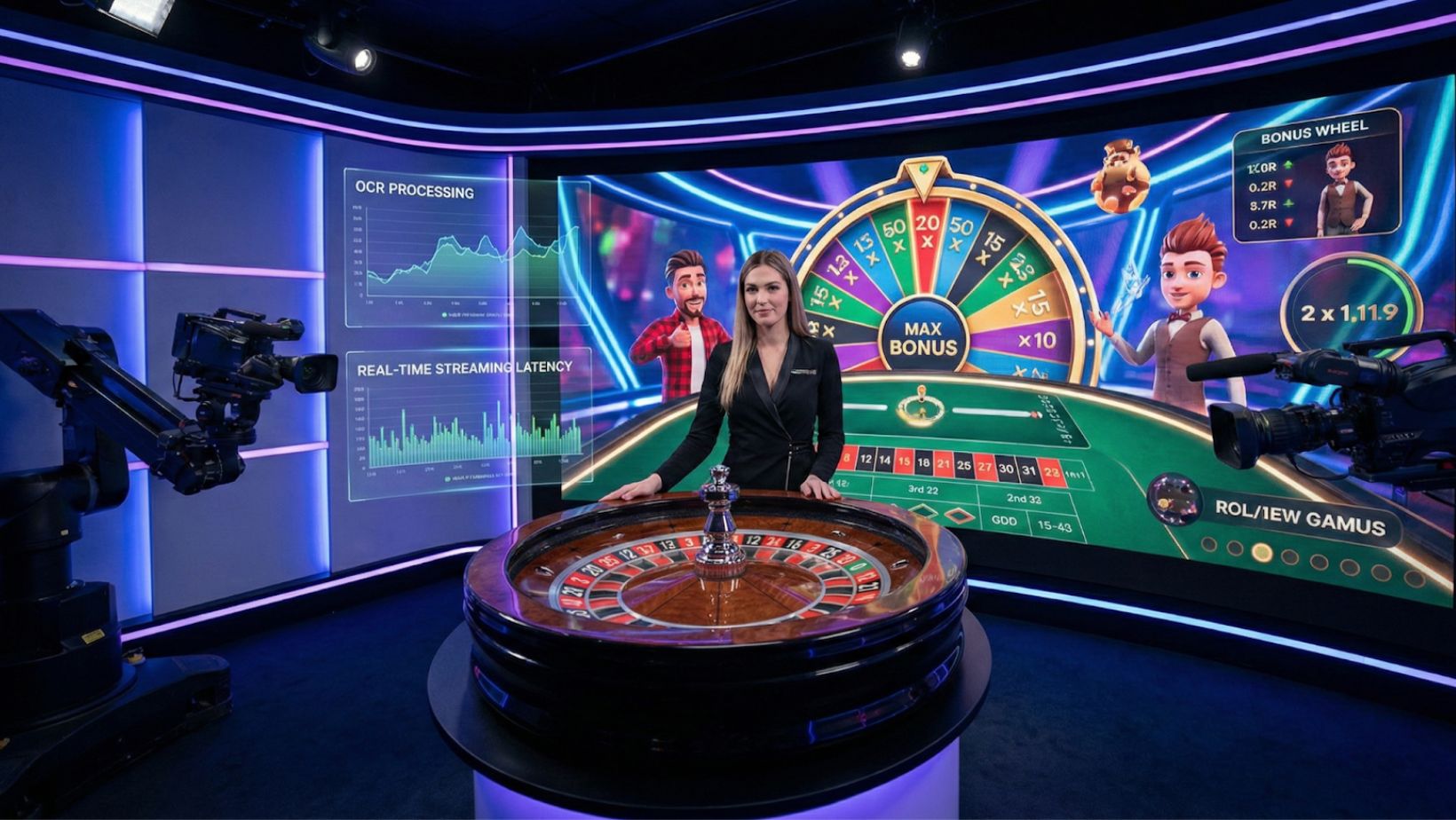
The core technology driving this sector is Optical Character Recognition (OCR). Every card dealt, every spin of the roulette wheel, and every roll of the dice is instantly scanned by OCR technology. This software translates physical actions into digital data, which is then overlaid onto the user interface (UI) in milliseconds. This allows the system to settle rounds, update balances, and manage game states without human intervention.
The Challenge of Latency
In a sector where trust and “real-time” interaction are paramount, latency is the primary adversary. Modern platforms utilize advanced Content Delivery Networks (CDNs) and adaptive bitrate streaming to ensure that a player in Tokyo sees the same card turn as a player in London, at the exact same moment. This synchronization is critical for “Community Games”—a genre where hundreds of players bet on the same hand or spin simultaneously.
Gamification: The Shift to “Game Shows”
Perhaps the most significant development relevant to the gamification sector is the pivot from traditional casino games (like Baccarat or Blackjack) to “Game Shows.” Providers like Evolution and Playtech have recognized that the modern demographic, raised on video games and mobile apps, requires higher engagement levels than traditional formats provide.
This has led to the introduction of Augmented Reality (AR) and RNG multipliers into live streams.
Mechanics of Hybrid Games
In titles such as Monopoly Live or Crazy Time, the base game might be a physical wheel, but the bonus rounds are entirely digital, 3D-rendered environments. Here, the mechanics shift:
- Base Game: Low volatility, frequent hits, relies on physical physics.
- Bonus Rounds: High volatility, governed by RNG, utilizes rich visual effects and narrative elements.
This hybrid approach keeps the player engaged through visual stimulation and distinct “stages” of play, mirroring the progression systems found in mobile RPGs or casual games.
Understanding Volatility and RTP in a Live Context

From an analytical perspective, the introduction of gamification elements has fundamentally changed the mathematical profile of these games. Traditional table games are known for high RTP (Return to Player)—often exceeding 99% in optimal play scenarios—and low volatility.
However, the new wave of gamified live shows often lowers the base RTP (hovering between 95% and 96%) while drastically increasing volatility. This is achieved through “multipliers,” a mechanic borrowed from slot machines.
The Complexity of Rule Variations
With the explosion of variants—such as “Lightning” or “Quantum” versions of standard games—the rule sets have become increasingly intricate. A standard Blackjack game behaves differently from a version where random multipliers are applied to specific cards.
This complexity creates a need for deep analytical understanding. Players and analysts can no longer assume standard probabilities apply. Detailed technical breakdowns are essential to understand how a “2x” multiplier impacts the House Edge or how side-bets affect the overall variance. Specialized analytical hubs, for example, LiveCasinoComparer, focus on dissecting these specific technical nuances, offering comparisons on how different providers tweak streaming latency, UI responsiveness, and RTP configurations across similar game titles. Understanding these subtle differences is crucial for grasping how the product is balanced.
The Role of Social Interaction and UI
Gamification is not just about the game mechanics; it is about the social layer. Early online casinos were solitary experiences. Modern live dealer interfaces have integrated:
- Live Chat: Allowing interaction between players and the host, turning the dealer into a “streamer” or entertainer rather than just a functionary.
- Bet Behind: A mechanic allowing players to bet on the actions of other “winning” players, creating a passive gameplay loop similar to Twitch integration.
- Lobby Integration: Seamless switching between tables without loading screens (using “Picture-in-Picture” modes).
These UI decisions are designed to reduce friction and maintain immersion, principles that are central to effective gamification strategies in non-gambling contexts as well.
Future Horizons: VR and AI Dealers
Looking forward, the sector is poised for another leap.
- Virtual Reality (VR): While currently niche, VR integration aims to place the player physically “inside” the studio. The challenge remains hardware adoption and the nausea associated with movement in VR, but the immersive potential for live events is unmatched.
- AI Hosts: We are beginning to see the testing of hyper-realistic AI avatars acting as dealers. These can operate 24/7, speak any language fluently based on the user’s IP address, and offer personalized interactions that human dealers cannot scale.
Conclusion
The live dealer sector serves as a fascinating case study for the application of gamification and high-end streaming technology. It has successfully transitioned from a static digitization of physical games to a dynamic, multimedia entertainment product.
By blending the reliability of OCR technology with the engagement loops of video games (multipliers, bonus stages, AR), the industry has created a hybrid format that continues to push the boundaries of what is possible in real-time interaction. For developers and gamification experts, the evolution of this niche offers valuable lessons in user engagement, interface design, and the management of high-frequency data in a live environment.