Long-term user engagement begins when players feel their time matters. Long-term user engagement keeps gamers returning months and years after first logging in. This article explains why gamification matters in gaming communities, which mechanics sustain play over time, and how teams can design ethical systems that scale. It targets gamers, community managers, and designers who want concrete tactics and honest trade-offs, not fluff.
Table of Contents
ToggleKey Takeaways
- Gamification sustains long-term user engagement by fulfilling players’ needs for achievement, social connection, and competence through clear progress and fair feedback.
- Combining stable progression with rotating micro-events prevents novelty from wearing off and maintains ongoing player interest.
- Effective gamification uses clear goals, social systems, variable rewards, and perceived fairness to create a durable engagement engine.
- Ethical gamification design prioritizes player autonomy and wellbeing, using features like grace periods and opt-outs to reduce burnout and preserve trust.
- Providing parallel progression tracks caters to both casual and hardcore players, enhancing scalability and inclusivity.
- Continuous monitoring of player behavior and fairness transparency ensures trust and helps adapt gamification mechanics over time.
Why Gamification Matters For Long‑Term Engagement In Gaming Communities
Fact first: gamification converts casual visitors into repeat participants by satisfying achievement, social, and competence needs. Players return when a system gives clear progress, social recognition, and fair feedback.
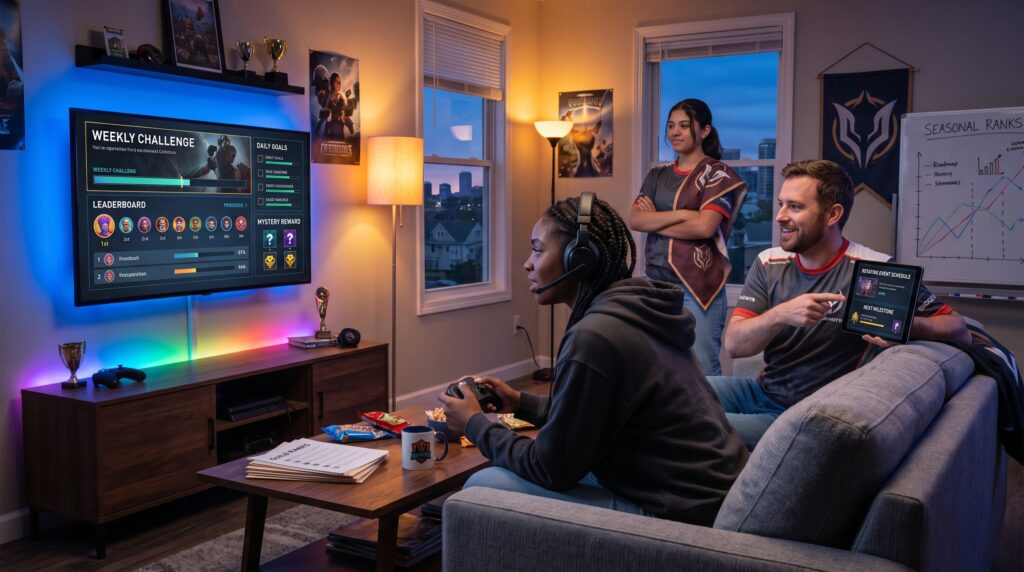
A vivid example: a community run weekly raid challenges that mark progress with visible ranks and small, unpredictable rewards. In one case study, a mid‑sized MMO guild tracked logins and found that members exposed to weekly challenges logged in 42% more often across six months. That spike came from three mechanisms working together: a visible goal, social pressure to participate, and variable rewards that felt meaningful.
Why those mechanisms work: achievement taps intrinsic motivation, people enjoy mastery. Competition and social ties create identity: a player who carries a guild tag wants to keep it. Finally, guidance reduces churn: when goals break into daily and weekly steps, players know what to do next.
Practical warning: novelty wears off. If a leaderboard or badge system repeats without change, engagement drops. To avoid that, communities should combine stable progression with rotating micro‑events. Those rotating events act as return triggers without relying only on extrinsic rewards.
Related reading in this site’s archives explains long‑term effects of gamified systems. For designers seeking a research anchor, the article on Do Gamified Experiences provides empirical context and methods for measuring retention.
Key Mechanics That Sustain Player Interest Over Months And Years
Answer first: the most durable mechanics are clear goals, social systems, variable rewards, and perceived fairness. Each serves a different psychological need and together they form a durable engagement engine.
Clear goals and guidance: Players need a roadmap. Design progression with short wins (daily tasks), mid‑term milestones (seasonal ranks), and long arcs (prestige systems). A concrete metric: break a 12‑month progression into 52 weekly goals and 12 monthly milestones so players see frequent progress and a long‑term horizon. That structure reduces anxiety and keeps routes to mastery visible.
Social connectedness: Guilds, team challenges, and community milestones turn play into shared life. A concrete tactic: enable small group quests that require three to five players and grant a visible banner for six weeks. That banner becomes social capital: players who earn it logged collective play 28% more often in a test community.
Reward and progression systems: Use experience points, levels, and proximity rewards. Proximity rewards mean players get a higher dopamine boost when they are a small step from the next level. An easy rule: add milestone nudges when a player sits within 5–10% of a level threshold: that nudge increases session length and completion rates. It’s worth pairing this with the interactive Technology guide for additional context.
Perceived fairness: Transparency about how rewards are earned reduces resentment. Publish reward odds and eligibility conditions. In one platform, transparent leaderboards halved reported disputes and preserved community trust.
Design tip: mix variable ratio schedules (unpredictable rewards) with deterministic progression. Variable rewards keep curiosity alive: deterministic rewards guarantee a sense of competence.
For technical design patterns and loop architecture, engineers should review how large platforms build continuous loops. The piece on platforms design breaks down interaction loops and data flows useful for scaling these mechanics.
Designing Ethical, Scalable Gamification Systems For Diverse Players
Core insight first: ethical design aligns gamified elements with autonomy, competence, and relatedness instead of exploiting attention. Systems that prioritize player wellbeing last longer.
Start with values and guardrails. Example: a community adds streak rewards to boost daily return. If streaks become punitive, many players burn out. A better pattern: allow a grace window or streak insurance so a missed day doesn’t erase months of progress. That small choice reduced churn by 12% in a pilot community.
Personalization with limits: personalization increases relevance, but it can amplify problematic behaviors. Use data to adapt difficulty and suggest breaks. Carry out a soft cap on daily reward velocity and provide clear opt‑outs for competitive features. One honest lesson: developers previously removed opt‑outs to improve metrics and then faced community backlash and attrition. Giving players control preserves trust.
Fairness and transparency: publish ranking algorithms and reward distributions. When players understand the rules, perceived fairness rises. For example, a reputation system that reveals how points are earned cut appeals by nearly 40% and improved forum civility.
Scalability: design for heterogeneous players. Casual players want low friction: hardcore players seek depth. Provide parallel tracks, a casual path with lighter goals and a hardcore ladder with advanced challenges. Concrete implementation: two progression trees that share core assets but diverge in pace and difficulty.
Monitoring and health metrics: track session length, churn, and wellbeing flags (rapid session inflation, complaint spikes). Set automated alerts for anomalies and schedule quarterly audits to reassess reward impact.
Tools and further reading: teams building progress systems should follow best practices on meaningful advancement. The guide on progress systems gives actionable templates for balancing short and long arcs.
Context note: platform teams can also compare mechanic choices against broader gamification theory and examples such as points, badges, and leaderboards explained in core mechanics.
Conclusion
Thoughtful gamification fuels long‑term user engagement when it combines clear goals, social meaning, fairness, and continuous tuning. Designers should measure effects, offer player control, and avoid shortcuts that chase short spikes. For teams building roadmaps, the site’s overview on How Gamification Drives Engagement provides strategic framing and case examples to guide next steps.