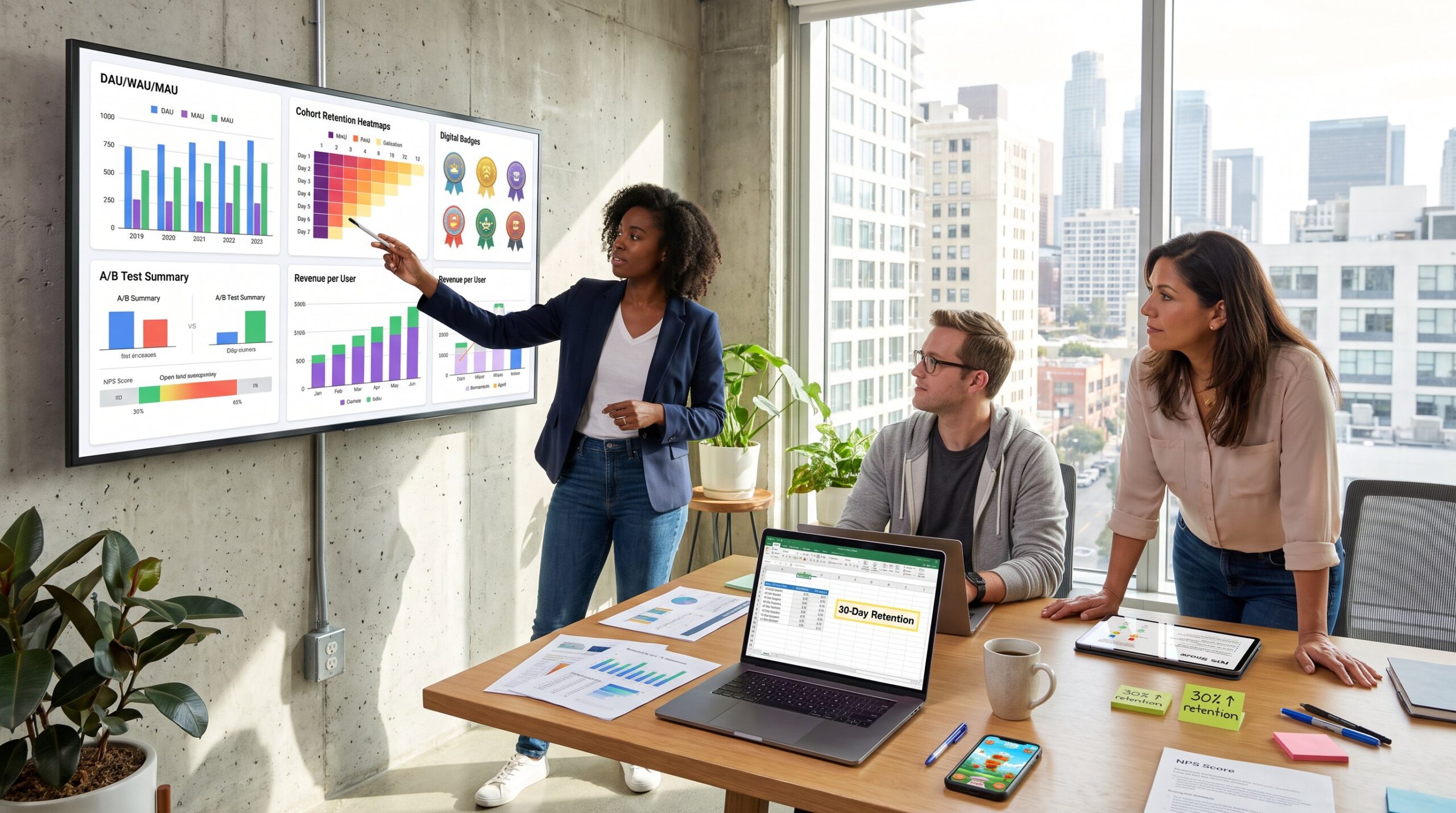

Mobile gaming has moved well beyond simple mechanics and standard reward loops. The strongest titles now treat players less like a broad audience and more like individuals, adjusting content, challenge, and rewards around actual behavior. An AI-powered personalization loop is not just something big studios with huge engineering teams can afford to build anymore. With a practical framework in place, indie developers and mid-sized teams can roll it out in a structured, realistic way.
Table of Contents
ToggleWhat a Personalization Loop Actually Means
Before getting into the setup, it helps to clarify what the loop really is. At its core, a personalization loop is an ongoing cycle: player behavior creates data, that data is fed into an AI model, and the model uses it to shape what the player sees or experiences next. Then the cycle runs again, ideally getting smarter with every pass.
Understanding the role of AI in online gaming helps frame why this matters. AI is not just there to automate choices. Its real value is in spotting patterns across thousands of players that would be almost impossible to identify manually, then applying those insights to individual players in real time.
Step 1 — Define Your Event Tracking Schema
Everything starts with clean, reliable data. Before a team writes any AI logic, it needs to decide which player actions are worth tracking and how those events will be recorded. Common high-value events include:
- Session start and end timestamps
- Level attempts, completions and abandonment points
- In-app purchase triggers and drop-offs
- Feature interactions (social sharing, daily login streaks, tutorial skips)
- Notification response rates
Every event should include consistent metadata: player ID, session ID, device type, game version and timestamp. If naming conventions are messy or important fields are missing, the model will be learning from flawed input later on. Tools like Firebase Analytics, Amplitude or Mixpanel are usually more than enough to handle this layer for most mobile game stacks.
Step 2 — Build Segmentation Before Personalization
Raw event data, by itself, does not create personalization. The next step is to group players into behavioral segments based on how they actually play. Typical segments include:
- Casual players — short sessions, low purchase intent, high churn risk
- Engaged explorers — long sessions, feature-curious, moderate spend
- High-value converters — repeat purchasers, community participants, low churn
These segments give your A/B testing strategy a much stronger foundation. Instead of testing personalization changes across the entire player base, you can run targeted experiments inside each segment and get cleaner, more useful results. This is also where how data analytics can drive profits in mobile gaming becomes especially relevant, because segmentation is what turns raw behavior into decisions that can affect retention and revenue.
Step 3 — Design and Run Meaningful A/B Tests
A/B testing inside a personalization loop is a little different from standard feature testing. You are not just looking for what most players prefer overall. You are trying to understand how different segments respond to different conditions.
For each segment, isolate one variable per test cycle. Examples include:
- Reward timing — immediate vs. delayed gratification after level completion
- Difficulty curves — gradual vs. steeper challenge escalation
- Notification copy and frequency
- Onboarding path length
Let the tests run long enough to produce statistically meaningful results. One of the most common mistakes in mobile game optimization is ending a test too early because the first signals look encouraging. When handled properly, each result feeds back into the segmentation model and helps sharpen it over time.
Step 4 — Connect the AI Layer
Once you have clean event data and a clearer view of segment behavior, the AI layer can start making real-time decisions. Depending on the team’s resources, that decision engine might be a recommendation system, a reinforcement learning model or even a simpler rule-based ML classifier.
The model takes in a player’s current session context — recent events, segment membership, historical behavior — and returns a personalized parameter for the next experience. That could mean a specific offer, a difficulty tweak or a content recommendation. Whatever the output is, it should be logged as a new event so it can feed the loop again.
This same structure is behind personalized gaming experiences across the wider gaming industry, from mobile games to browser-based platforms. The basic logic stays the same, even if the implementation grows from lightweight rules to deeper learning systems as infrastructure improves.
Where This Approach Appears Across Digital Entertainment
AI-driven personalization is not limited to mobile games. The same mix of event tracking and segmentation shows up across digital entertainment more broadly. Streaming services use it to surface content. E-commerce platforms use it to order product recommendations. Online gaming platforms apply similar frameworks to shape player journeys around session behavior. Dutch players exploring platforms like SuperBigWin.nu encounter interfaces shaped by comparable data-driven logic, where content presentation adapts to individual interaction patterns. The technical principles stay largely the same, even when the entertainment format itself looks very different.
Closing the Loop and Iterating
An AI personalization loop is never really finished. Every testing cycle adds new data, and that new data helps improve the model. The discipline that matters most is consistency: collect, segment, test, deploy, measure and repeat.
Teams that establish that rhythm early usually see personalization compound over time. Retention improves not because of one dramatic feature update, but because each player touchpoint gets a little more relevant with every cycle. That cumulative effect is often what separates games with lasting engagement from those that spike briefly and then fade.