
Few video game characters achieve recognition across multiple generations. The journey of Nintendo’s mascot, however, did not begin with the iconic figure we know today. His path to global fame was a series of calculated reinventions. We think his story is a masterclass in brand evolution. It’s a case study in keeping something familiar feeling fresh for over four decades.
Mario’s recognizability is a global phenomenon. Even those who have never held a controller can usually identify the Italian plumber. His image is simply everywhere. This wasn’t always the case. His origins were far more humble, a mere pixelated sketch in an arcade cabinet. He was a solution to a problem, not a planned superstar. That’s what makes his ascent so interesting.
The Nintendo Foundation: From Cards to Consoles
To understand Mario, you have to look at the company behind him. Nintendo’s own history is one of radical adaptation. Founded in 1889, it spent most of a century as a successful playing card company. The shift to toys and eventually electronics in the 1960s was a risky pivot. They were outsiders.
The 1970s saw them dabbling in arcades with mixed results. A pivotal moment came with the failure of Radar Scope in the US market. Thousands of unsold cabinets sat in warehouses, a financial disaster. This crisis forced Nintendo to get creative. They tasked a young artist, Shigeru Miyamoto, with designing a new game that could be installed on the existing Radar Scope hardware. This constraint bred innovation. From the wreckage of one failure emerged the blueprint for a legend. It’s a story of turning a disaster into a defining opportunity.
Early Beginnings as Jumpman (1981)
The character debuted in the 1981 arcade hit Donkey Kong. He wasn’t called Mario then. Artists and designers referred to him as Jumpman, a carpenter tasked with a simple mission. His goal was rescuing a character named Pauline from a giant ape. This basic rescue premise would define many future narratives. At this stage:
- • He was known as Jumpman.
- • His role was carpenter.
- • The core premise was rescue.
His visual identity crystallized during this period. The team gave him a red cap and overalls, a design choice born from technical limitations of the time. Rendering realistic hair was a pain, so they gave him a hat. Facial animation was tough, hence the prominent mustache.
This practical solution created an enduring look. The character was visually distinct even at low resolution. You could always tell what he was supposed to be.
Introduction of Mario and Luigi (1983)
The 1983 arcade game Mario Bros. marked his official christening. The Jumpman persona was retired, and the name Mario, reportedly inspired by a Nintendo landlord, took center stage. His profession shifted curiously from carpenter to plumber, a change that fit the game’s subterranean settings. Maybe the developers thought it was a more exciting job.
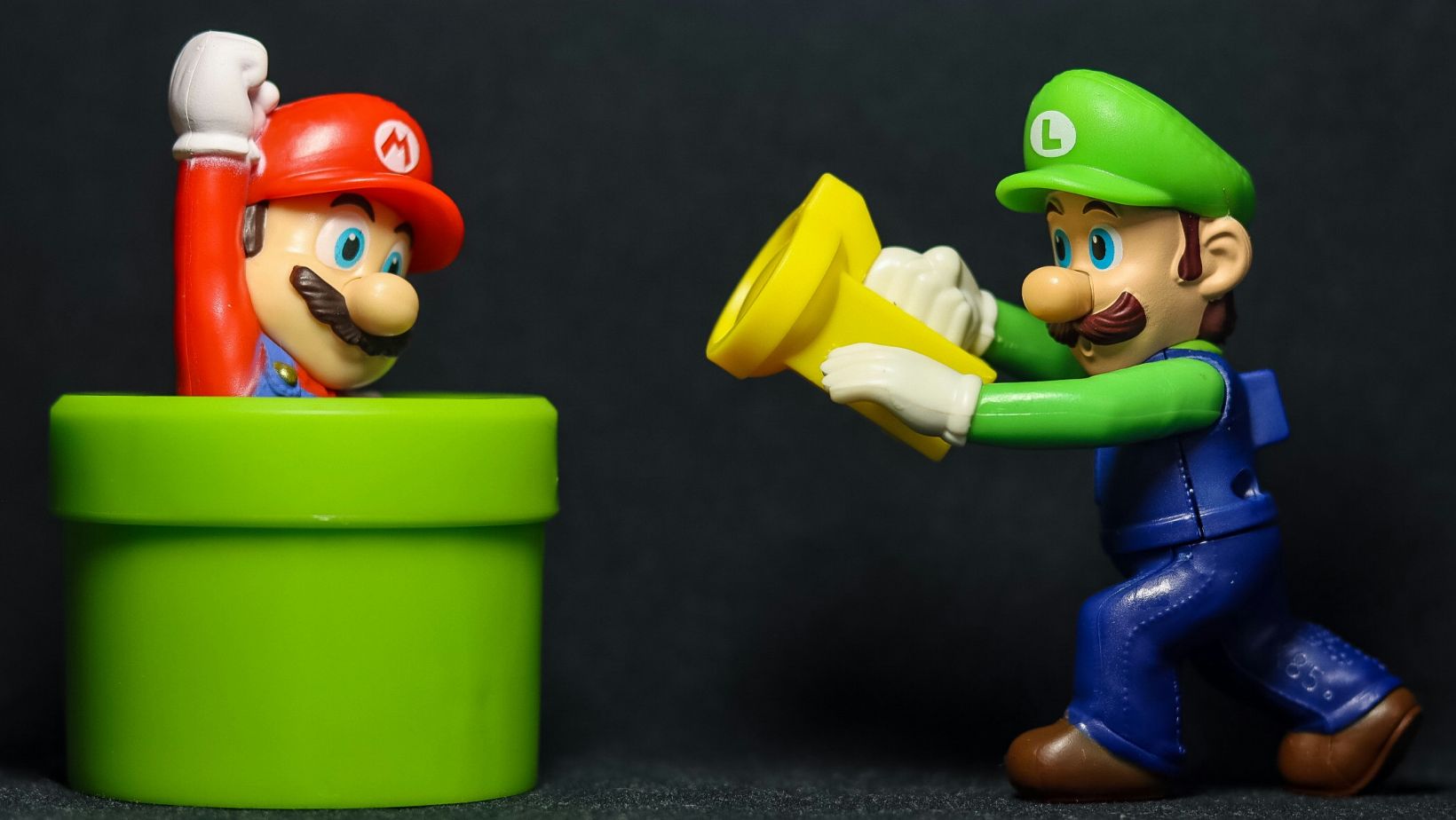
This title also introduced his taller, greener brother, Luigi. His inclusion was pivotal, establishing the cooperative and competitive multiplayer dynamics that would become a franchise staple. Suddenly, it wasn’t a solo mission anymore. It was a family business. Luigi started as a simple palette swap, a technical trick to create a second player. But he quickly grew into his own personality, the nervous counterpart to Mario’s confidence.
Nintendo’s Expansion into Home Consoles (1983–1986)
Nintendo’s ambitions stretched beyond arcades. The launch of the Family Computer (Famicom) in Japan began a new living room era. Its Western counterpart, the Nintendo Entertainment System (NES), faced a skeptical American market after the video game crash of 1983. It needed a killer app. The pack-in game Super Mario Bros was that phenomenon. It was the system seller. Key shift in this phase:
- • Transition from arcades to home consoles.
- • NES adoption heavily tied to Super Mario Bros.
- • Mario became the recognizable face of the brand.
The game’s impact was immediate and massive. It wasn’t just another title. It was a cultural event that helped resurrect a struggling industry. The side-scrolling platformer defined the genre for decades. Its design philosophy, hidden secrets and precise controls made the game feel new. For many, the NES was Mario. The character and the console became inseparable in the public mind. The legacy of that initial release remains potent.
The 16-Bit Leap and Establishing a Universe
The move to the Super Nintendo came with Super Mario World. It was more than updated graphics. The world felt wider. Yoshi changed how the character moved and interacted with levels. The map screen made the game feel like a place instead of a sequence of stages.
The game also had depth. Star Road and the Special Zones gave experienced players something to chase. The Koopalings had distinct personalities. The world felt more connected and intentional. Super Mario World showed that a sequel could expand scale and still stay familiar.
Growth of the Franchise Across Genres (1990s–2010s)
The franchise refused to be pigeonholed. Nintendo aggressively expanded the Mario universe into new genres, a move that solidified his status as a versatile star, not just a platforming hero.
Platformers and Core Titles
The core platforming series kept evolving. Then came the seismic shift to 3D with Super Mario 64. It redefined navigation for the entire medium. The analog stick became an extension of Mario’s body. Later games like Super Mario Galaxy took the formula to a literal cosmic scale, playing with gravity and physics in ways that were mind-bending. Each entry refined the core jumping and running mechanics while introducing a new hook.
Sports and Party Games
This is where Mario’s brand exploded. Mario Kart transformed him into a racing champion, creating a party game institution. Mario Tennis and Mario Golf made him a sports star, blending arcade fun with surprising depth. The Mario Party series became a digital board game night for friends, a catalyst for both joy and friendly rivalry.
These spin-offs were genius. They kept the character relevant between major platform releases and introduced his world to audiences who might not enjoy traditional platformers. The guy was suddenly in every genre imaginable.
Handheld and Portable Systems
Mario’s dominance wasn’t confined to television. He was a constant presence on every Nintendo handheld. From the original Game Boy to the DS and 3DS, he was a system-seller. Games like Super Mario Land proved full-fat Mario experiences were possible on the go.
The DS era, with games like Super Mario Bros, triggered a renaissance for 2D gameplay. This portable strategy ensured a new generation of kids, often with their first personal gaming device, formed a connection with the character. He was a pocket-sized companion.
The Supporting Cast: More Than Just Sidekicks
A hero is shaped by the world around him, and Mario’s world grew alongside him. Princess Peach is no longer just someone who needs rescuing. She runs a kingdom, takes the lead in some stories, and stands on equal footing in others. Bowser also changed. He isn’t just a villain now. He can be threatening, comedic, or even weirdly relatable depending on the game. Toad, Yoshi, and Donkey Kong followed the same path. They stopped being background characters and became recognizable personalities.
This group of characters keeps the setting from feeling empty. There is a sense that the Mushroom Kingdom has history and daily life behind the action. You move through a place that feels lived in. It’s not only a sequence of levels to clear. It’s a setting that players come back to because it feels familiar and welcoming.
Cultural and Industry Impact
Mario became more than a collection of pixels. He evolved into the official face of Nintendo, a corporate mascot as recognizable as any in the world. His influence seeped into broader pop culture through cartoons, a notoriously bad Hollywood film, and endless merchandise. The shape of his cap is globally understood. In cultural terms:
- • Widely recognized across age groups.
- • Present in television, film, and merchandise.
- • Functions as Nintendo’s primary public identity.
Mario influenced how many games are made. Super Mario Bros shaped the way levels teach players as they go. Super Mario 64 changed how movement and camera control work in 3D spaces. Mario Kart and the main platformers also gave people a reason to play together. And the coin sound is still instantly recognizable.
Mario Today
On the Nintendo Switch, Mario is still central. Super Mario Odyssey introduced new ideas while keeping the familiar structure. Updated classics and mobile titles bring him to new players. The 2023 animated film showed that the character works outside games too.
The franchise has sold over 400 million units. Mario remains a consistent presence in an industry that changes quickly.
Conclusion
Mario’s stability over decades is a rare feat in entertainment. He has avoided the stagnation that plagued many of his contemporaries. The character remains culturally vital because Nintendo continually allows him to adapt while protecting his essential, recognizable spirit. He is both a comforting constant and a source of genuine innovation. That’s a tough balance to get right, honestly. They’ve managed it for over forty years. He started as a pixelated carpenter and became a modern myth. That’s one heck of a career progression.