
How I love and fear the mysteries of space—standing on the surface of a lifeless planet millions of light-years from Earth, or staring into the blazing heart of a distant black hole. Routine lets you experience that same mixture of awe and terror, where the darkness outside your porthole is as thrilling as it is frightening.
A lunar sonata of horror and deligh
Indeed, one of the strongest impressions from Routine came the first time I was let out onto the surface of the Moon. I stood there for a long time, taking in the barren rocks against the surrounding darkness, staring at the Earth hanging in the sky—where someone is now sitting and playing Routine. At some point, I decided not to head to the next compartment of the station, but to venture into the black-and-white distance beckoning with its unknown. Such vivid impressions are made possible by how tactile and authentic the atmosphere and the entire setting of the game feel.
Man on the Moon
Indeed, one of the strongest impressions from Routine came the first time I was let out onto the surface of the Moon. I stood there for a long time, taking in the barren rocks against the surrounding darkness, staring at the Earth hanging in the sky—where someone is now sitting and playing Routine. At some point, I decided not to head to the next compartment of the station, but to venture into the black-and-white distance beckoning with its unknown. Such vivid impressions are made possible by how tactile and authentic the atmosphere and the entire setting of the game feel.
Don’t you want to step into the distance and see what lies ahead?
My first impressions were mixed, a blend of horror and delight. On one hand, the photorealistic graphics and the feeling of being in a real, abandoned station are terrifying. Every step feels tense, especially with the constant creaks, howls, and other unsettling sounds in the darkness.
On the other hand, you can easily get stuck for a long time in the first room aboard the Union Plaza complex, where our nameless software engineer wakes up after a seven-day quarantine. Once you finally get out, you may spend another hour just figuring out how the IPK (Individual Cosmonaut Assistant)—our main and universal device—works. Throughout the game, we interact with terminals and other equipment, all without hand-holding.
The game deliberately avoids markers or guidance, forcing you to write everything down or memorise it, just as a real person would when told their ID number is on the badge in their breast pocket. You actually have to look at your chest instead of searching a journal or inventory. Devices are introduced through brochures on tables rather than tutorials, and the journal is limited—you can only check it in safe zones to clarify tasks and access the database of collected codes and materials via the IPC screen.
You adapt to this quickly and realise why the designers chose this approach—it reinforces the effect of presence. But at first, the unfamiliarity can be frustrating, and you may want to swear at the inconvenience. It’s a style rarely seen in modern games, and that’s part of what makes Routine so memorable. For players who enjoy immersive experiences and the thrill of discovering rewards on their own, this is not unlike the excitement of claiming a Stay Casino no deposit bonus, where the anticipation and self-guided exploration make the experience even more rewarding.
Lunar gait
This brings to mind games from the past—and I’m not just talking about obvious comparisons with Alien: Isolation, but also System Shock 2. In Routine, you can explore the space station freely, collecting notes, solving puzzles, and hiding or running from enemies. You can even choose the order in which to complete tasks and which sector to visit first. For instance, someone could tackle the Union Plaza shopping centre in the first chapter, while I went straight to the residential sector.
I was not welcomed in the residential sector. If it were up to me, I would have spent the entire game on the Moon. At times, the game hints at complete immersion, and for the most part, it delivers. Yet despite all these cues, you still have to solve certain tasks in predetermined ways.
It’s clear this isn’t a cinematic horror game filled with spectacular jump scares or thrilling chase sequences, but Routine contains many scripted scenes—like sudden attacks or characters being locked up. They’re not inherently good or bad, but they work effectively for the atmosphere. Some jump scares even made me flinch and swear, which doesn’t happen in all horror games.
Interestingly, in Routine’s original concept, there were no specific tasks to solve at all. It was planned as a walking simulator in the spirit of Dear Esther. In a way, it still retains that feeling—much of the time, you walk from point A to point B, figuring out how to open the next door using the IPC.
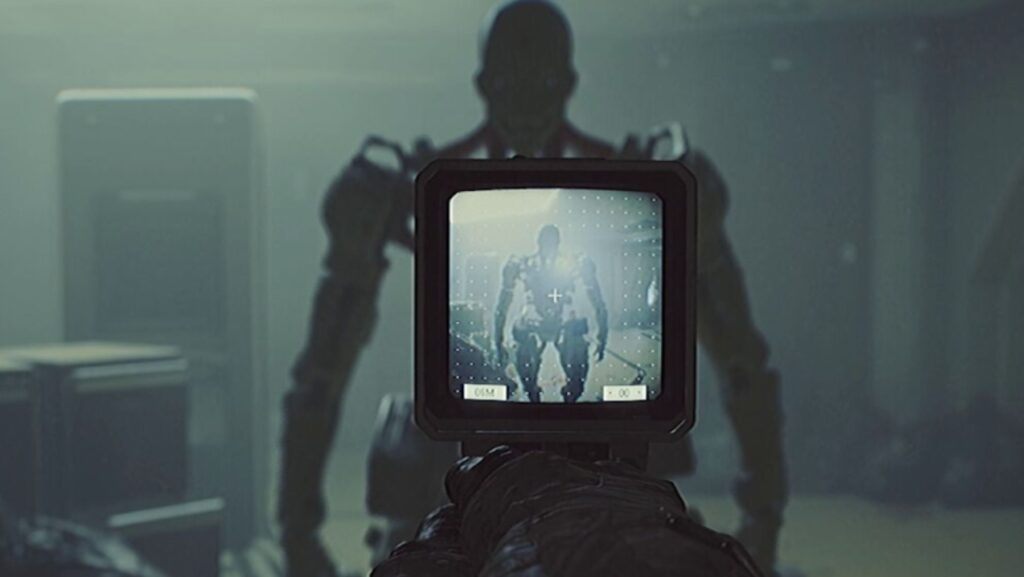
The device itself has multiple modes. In one, you might need to shoot a distribution box. In another, after acquiring a new IPK module, you scan prints on a code panel with ultraviolet light. In a third mode, you play a mini-game to gain access to new compartments—but only after raising your device’s access level. In this sense, Routine is less reminiscent of System Shock or Alien: Isolation, and more like Five Nights at Freddy’s: Secret of the Mimic, where progression is similarly tied to using and upgrading a key gadget to open doors.
Essence, robots and death
In the second half of the game, the walking and door-opening simulator aspect can become a bit much—constant runs from point A to point B, combined with a lack of clear instructions on where to go, start to tire and annoy. But, thank God, that’s not where Routine’s gameplay ends. There are also puzzles—not just those involving the IPC, access cards, or codes and passwords.
You turn valves, mix chemicals, and create mixtures based on cleverly devised clues, which are challenging enough to figure out. One of the best puzzles in the game requires deciphering a two-way cipher, involving scanning the locations shown in a photo using ultraviolet light. Some codes can also be seen via video cameras. This isn’t a spoiler—the numbers are randomly generated each time.
And, as mentioned earlier, you also need to hide from or run away from enemies. There are two main types. The first are robots, which, like the androids in Alien: Isolation, become aggressive and attack. You can shoot them with the IPK, but it takes several hits to temporarily disable them. The shooting is intentionally cumbersome, and the robots are fairly stupid, so it’s often easier to run. Even if two are on a level, only one is active at a time—you need to use this to your advantage. The iron enemies are intimidating in appearance, though there are also much more peaceful and amusing robots to encounter.
Somewhere in the middle of the game, a mysterious entity appears. Shooting it is useless—once it spots the player, it quickly catches up and kills them. While it’s tempting to compare this monster to an alien, it falls short—the xenomorph is smarter, more dangerous, and scarier. Routine cannot be fairly compared to Alien: Isolation, as the stealth and gameplay in Creative Assembly’s game are more sophisticated and varied.

In my experience, I had to hide a couple of times, but often I could just run away, or the creature would disappear on its own, allowing me to continue. On one occasion, I stumbled upon it and saw the monster simply crouching—sleeping or meditating, perhaps. It looked like a neighbour who had escaped from a detox centre in his birthday suit. Yet when the ‘neighbour’ screams, catches up, and devours you, it’s genuinely terrifying.
Lunar secrets
Finally, the plot of Routine also leaves an impression—contradictory, of course. On one hand, the story feels typical. It begins in the 1970s (another reason to draw parallels with the universe of Alien), when scientists started studying a cave on the Moon called The Canal. At first, as revealed in the notes they left behind, they were thrilled by the chance to explore the mysteries of space and even discover a new form of life. And they did.
Then, as usual, horror ensued. Unknown creatures brought unknown diseases, people began to hallucinate, lose their memory, and write cryptic notes like: “I must join. We will finally be together!”
Yet the story in Routine goes beyond the usual pattern, which sets it apart from Alien: Isolation. In the System Shock duology, the plot revolves around a predictable confrontation with a mad artificial intelligence—SHODAN—who imagines herself to be a god. Routine, however, keeps its mysteries intact.
What exactly are these creatures? What happened to them, and what role do the strange flowers scattered throughout the game play? Whose voice do we hear from the very beginning, and what do phrases like “We will be together” and “The Moon and I need each other” mean? Not all questions are answered. Some players may dismiss the story as nonsensical, while others enjoy speculating and theorising. I lean toward the latter, but I don’t rule out the former. Either way, the plot stays true to genre conventions without becoming completely surreal, despite the many strange scenes and visions, maintaining a unique identity and sense of mystery.
Routine had a long, troubled development—it was first announced in 2012 during the Steam Greenlight era, and many had forgotten about it by the time it was re-announced three years ago. Few expected anything remarkable. Yet it emerged as one of the best horror games of the year, imbued with retrofuturism and the nostalgic atmosphere of classic science fiction. The experience can be contradictory, a mixture of horror and delight, reminiscent of seeing the lunar surface through your porthole for the first time. Still, these moments are among the most vivid emotions you’ll encounter in horror gaming.
Conclusion
Pros: Interesting plot; immersive lunar atmosphere; freedom to explore without being led by the hand; unique player gadget; engaging puzzles and gameplay situations; enemies capable of genuine scares; realistic graphics; outstanding sound design.
Cons: Primarily a walking simulator (albeit an extremely atmospheric one) combined with a door-opening simulator; lack of early-game hints can be confusing; some enemies are relatively easy to evade.