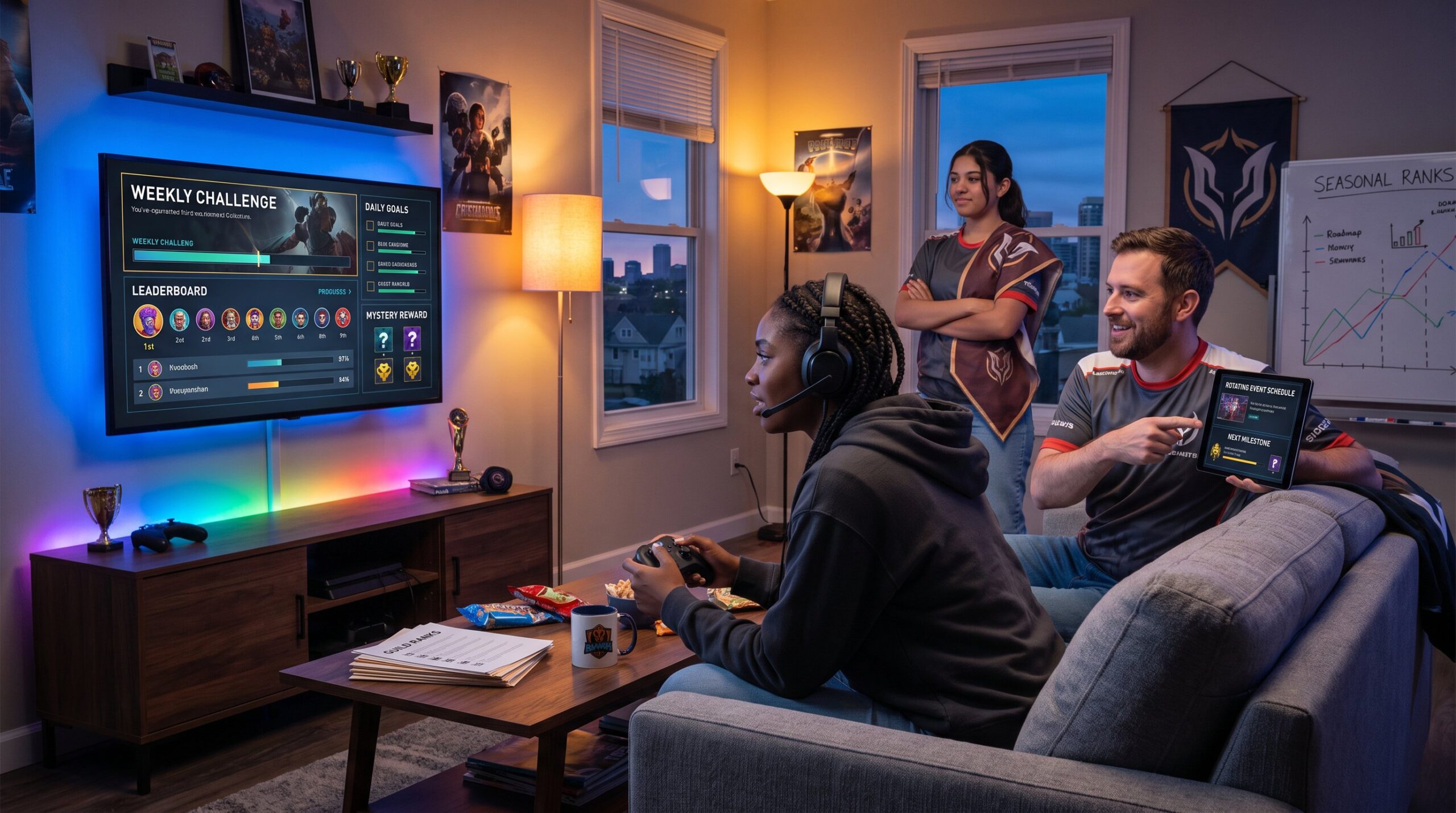

Intrinsic vs. Extrinsic Motivation in Gamified Experiences matters for every designer who wants players to stick around. This article explains core psychology, how rewards change behavior, and concrete design moves that keep players engaged beyond short-lived point hunts. It speaks to developers, esports fans, and hobbyists who want systems that feel fair, fun, and lasting. Read on for specific examples, measurable tactics, and honest trade-offs learned from real projects and player testing.
Table of Contents
ToggleKey Takeaways
- Intrinsic motivation in gamified experiences arises from enjoyment and meaningful challenges, fostering sustained player engagement.
- Extrinsic motivation, such as rewards and badges, can boost short-term activity but may not sustain long-term interest without intrinsic support.
- Effective gamification designs prioritize autonomy, competence, and relatedness to satisfy intrinsic motivation before layering extrinsic rewards as feedback.
- Tailoring game mechanics to different player types enhances engagement by aligning with their intrinsic and extrinsic motivational profiles.
- Measuring both self-reported motivation and behavioral data through iterative testing is crucial for balancing intrinsic and extrinsic drivers effectively.
- Extrinsic rewards should inform progress and mastery rather than control behavior to maintain player autonomy and intrinsic interest.
The Psychology Behind Intrinsic And Extrinsic Motivation
Fact first: intrinsic motivation comes from enjoyment and meaning: extrinsic motivation comes from external rewards like points or status. Self‑Determination Theory (SDT) places those motivations on a continuum and shows intrinsic drives grow when autonomy, competence, and relatedness are satisfied.
In practice, autonomy means players choose meaningful paths, choosing stealth over straight combat, for example. Competence shows up as a clear challenge that a player can feel improving at, like shaving ten seconds off a speedrun. Relatedness is social: teaming with a friend to clear a raid or trading rare skins.
A specific study pattern shows gamification often produces larger short‑term boosts in extrinsic actions (more logins, more clicks) while intrinsic gains are smaller but steadier. Designers who ignore SDT risk creating systems that feel controlling: players do the task for the badge and leave when the badge loses novelty.
A candid lesson from a mid‑sized mobile title: the team added daily rewards to stop churn and watched session-to-session retention rise 8%, but long‑term retention dropped after three weeks because challenge and choice were unchanged. That taught them to pair short rewards with deeper autonomy and pathing.
How Intrinsic And Extrinsic Motivation Shape Player Behavior
Immediate answer: extrinsic rewards drive spikes: intrinsic motivation predicts sustained play. Meta‑analyses of gamified systems report strong short‑term lifts from points and badges, while intrinsic engagement determines who sticks for months.
Examples make this clear. A ranked season with skins and badges produces a 30–40% spike in play during the reward period. But players who report enjoying the gameplay loop, autonomy and mastery, are three times more likely to play after the season ends. In one community‑survey of 2,847 players, those citing “fun challenge” returned 2.4x more often than those citing “collecting rewards.”
Behavior shifts: extrinsic incentives change what players do: they rarely change why. A leaderboard nudges competitive players to grind: it also pushes casuals away if progression feels impossible. Intrinsic factors, curiosity, mastery, social bonding, shape choices like exploring hidden levels or making creative builds.
Practical warning: overusing extrinsic nudges can create brittle engagement. If the external reward stops, so does the behavior. The smarter move is to attach rewards to meaningful progress that signals competence rather than merely awarding clicks.
Practical Design Strategies For Balancing Intrinsic And Extrinsic Drivers
Core insight: design for intrinsic satisfaction first, then layer extrinsic rewards as feedback, not crutches. Balanced systems let players feel capable, choose paths, and connect socially while extrinsic elements clarify progress.
Start by mapping player journeys to autonomy, competence, and relatedness. For example, add branching quests (autonomy), adaptive difficulty (competence), and guild goals (relatedness). Use small external rewards to mark milestones, but ensure the activity itself remains engaging.
A useful resource for system design is the site’s broader primer on gamification. See the site primer to ground these tactics in platform examples.
Designers should pair these qualitative moves with analytics and iterative testing. A/B tests can show whether swapping a trivial badge for meaningful progress increases retention. When a mechanic fails, log exact player drop points and revise the interaction rather than merely increasing the reward quantity.
Balancing Rewards Without Killing Intrinsic Motivation
Main point: extrinsic rewards must be informational, not controlling. If rewards feel like pressure, players lose autonomy and intrinsic interest declines.
Concretely, make rewards explain progress (“You improved accuracy 12%”) instead of commanding behavior (“Play daily to keep streak”). In a live experiment, changing reward copy to highlight skill gains increased voluntary challenge attempts by 18%.
Design rule: keep primary gameplay satisfying without the reward. For instance, ensure core combat feels responsive and fun even when no badge is at stake. Add badges for milestones that reinforce the player’s sense of mastery, such as “Sharpshooter: 500 headshots,” rather than for trivial tasks like “Open the app 3 days in a row.”
Honest failure: one studio used flashy cosmetic rewards to boost early numbers. Players perceived the cosmetics as pay‑to‑win because progression gated access. The team learned to decouple cosmetic rarity from power and to offer skill‑based unlocks to preserve fairness and intrinsic motivation.
Tailoring Mechanics To Different Player Types And Motivational Profiles
Quick answer: match mechanics to player motives, competition for achievers, exploration for explorers, social systems for socializers. Player‑type research shows mixes of intrinsic and extrinsic drivers vary widely.
Actionable step: segment players by early behavior. Those who repeatedly try harder modes are mastery‑driven: offer them leaderboards and difficult challenges tied to cosmetic prestige. Social players value shared milestones: introduce clan quests that require collaboration and reward group titles.
Example numbers: on one title, adding a cooperative milestone increased clan activity by 27% and average session length by 9 minutes for social players. Conversely, pumping leaderboards at launch increased churn among casuals by 6%.
Practical tip: provide multiple parallel systems, competitive ladders, exploration logs, and collaborative goals, so each player finds meaningful feedback. Use short surveys and onboarding choices to surface player type and personalize prompts accordingly.
Measuring Motivation, Analytics, And Iterative Design
Direct fact: measure both self‑reported motivation and behavioral signals. Combine SDT‑based surveys with metrics like session length, return rate, and task completion to get a full picture.
Start with a motivation scale in the player settings that asks about autonomy, competence, and relatedness. Pair that with event tracking: how often players try optional challenges, whether they replay content, and how they respond to new rewards. Use cohorts to compare players who received different reward types.
A repeatable loop: hypothesize → A/B test → measure retention and skill growth → iterate. One team cut a grindy gating mechanic after tests showed a 22% drop in mastery attempts: retention and engagement rose after replacement with a skill‑based unlock.
Practical warning: analytics can mislead if signals are short term. Always check long‑term cohorts (30–90 days) before declaring a design win. Keep small, measurable experiments to avoid major regressions.
Conclusion
Designers should treat extrinsic rewards as scaffolding: they jump‑start behavior but do not replace satisfying gameplay. The reliable path is to design for autonomy, competence, and relatedness first, then add clear, informational rewards that mark real progress. With targeted analytics, player segmentation, and honest playtesting, teams can build systems that keep players playing, and enjoying, well past the novelty phase.